
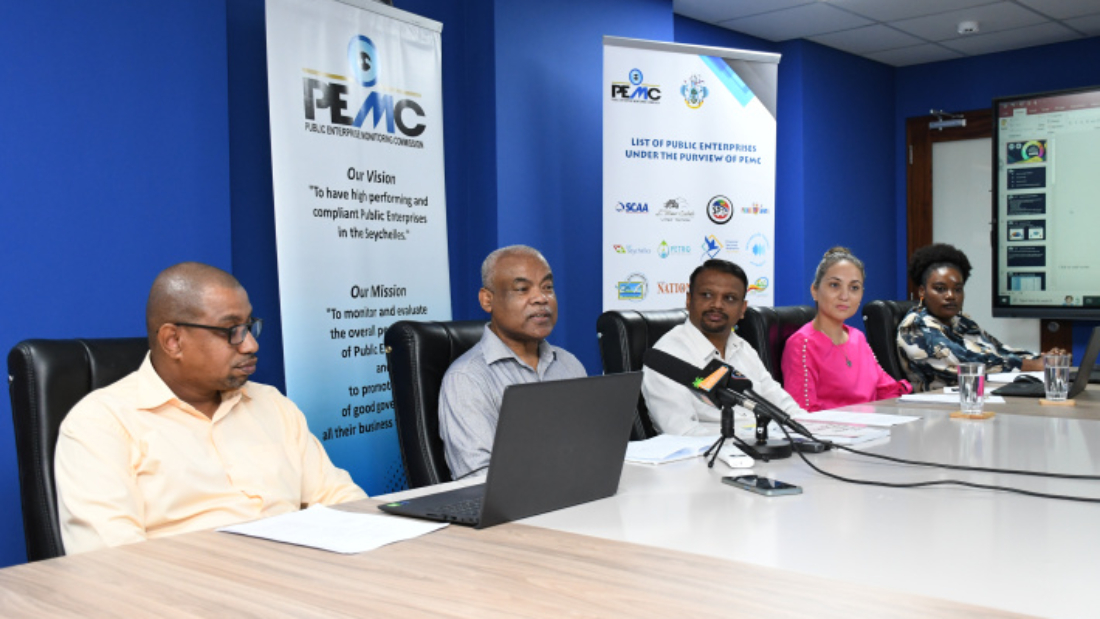
The Public Enterprise Monitoring Commission (PEMC) is satisfied with the performance of state-owned enterprises in Seychelles, during the year 2022.
There are presently 28 public enterprises (PEs) across the financial, energy, transport, and the services and development sectors. Additionally, there are four PEs in the banking and financial sector, namely the Dvelopment Bank of Seychelles (DBS), Nouvobanq, the Seychelles Commercial Bank, and the Housing Finance Company (HFC), although these do not fall under the purview of the PEMC. They are however included in the analysis for reporting purposes.
Of the 32 enterprises,l 24 were profitable in 2022 with a combined profit of R3.4 billion, compared to the previous year whereby only 20 recorded profits amounting to R428.1 million.
In terms of revenue, the PEs generated R17 billion in 2022, representing 61 percent of the country’s Gross Domestic Product (GDP), principal analyst Colette Jean-Louis noted.
“If we consider contributions in term of dividends from PE, we saw a good improvement in 2022 compared to 2021, with a dividend contribution of R 769.8 million This is a significant increase from 40 million in 2021” Ms. Jean-Louis stated.
There was a sigmfeant increase of 282 percent in business tax contributions, totalling R296. million in 2022. In comparison to 2022, only three entities, namely the DBS, the Seychelles postal Services, and the Seychelles Public Transport Corporation (SPTC) benefited from government subsidies amounting to R52.4 million. Subsidies amounted to R266.S million in 2021.
Air Seychelles was the most profitable in 2022, a performance that is attributed to its restructuring. However, in preceding years, the Seychelles Petroleum Company (Seypec) is the leading entity in terms of revenue generation and market share. Seypec is followed by the Public Utilities Corporation (PUC).
Chief executive Kalum Bandara made the distinction between PEs established for profit-making, and others that were setup to deliver social and economic benefits. These PEs include the SPTC, the Seychelles Trading Company (STC) and the National Information Services Agency (NISA).
“These PEs are performing but we lack a tool to capture the social benefits
distributed to the public In this direction, the PEMC, under the new Act, we are working closely with stakeholders to devise a mechanism or framework to quantify the value of the social benefits to the public” Mr Bandara stated.
The 2022 report was drafted in accordance with the PEMC Act 2013. However, a new PEMC Act was enacted in 2023, to address the inconsistencies identified in the past, while also taking into account emerging trends.
The PEMC Act (2023) emphasises the PEs legal obligations to submit all relevant documents and financial statements. Capacity-building is also a key component of the legislative framework.
“We are confident that we are able to make all PEs fully-compliant with the Act,” Mr Bandara added.
PEMC chairperson William Zarine highlighted the necessity for controls over PEs, considering their nature as commercial entities, who are faced with legal, financial, fiscal and operational risks.
The PEMC is an oversight body who represents the government, and promotes good governance, transparency, accountability and effectiveness within the entities.
Mr Bandara and and Mr Zarine were speaking during a press conference held at the PEMC headquarters, Providence. Also present were senior business analyst Alex Robert and business analyst Marela Servina.
Courtesy: Nation.sc